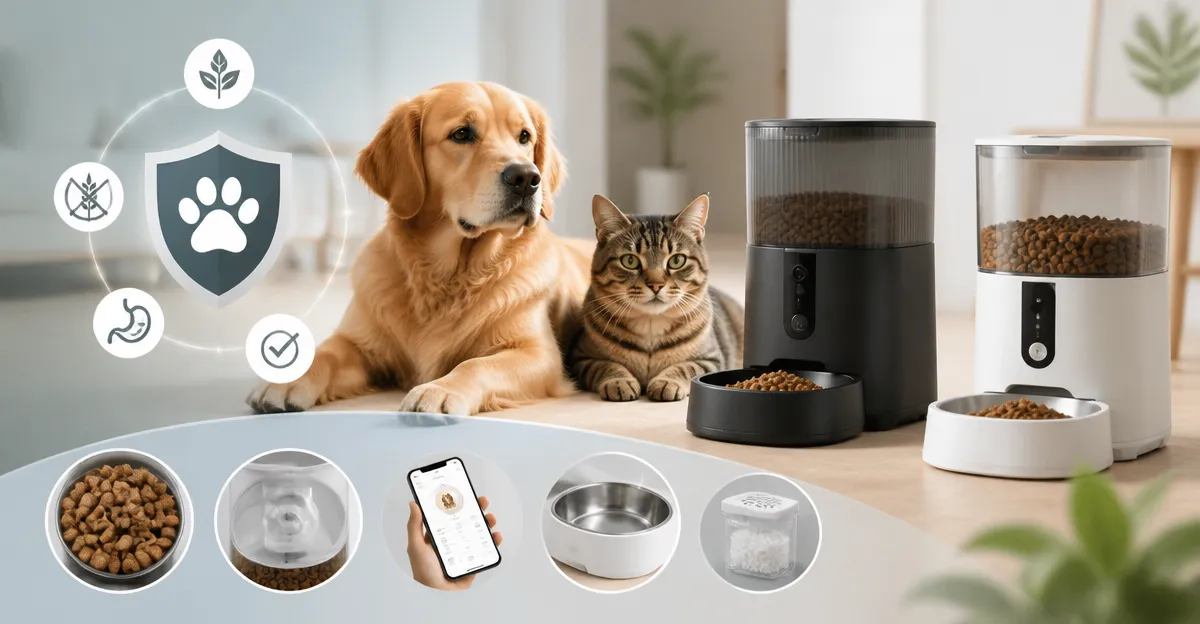
The Ultimate Guide to Smart Feeder Features for Pets with Food Allergies: Choosing Allergy‑Safe Automatic Feeders
Introduction
Pet owners whose animals suffer from food allergies require precise control over diet composition and timing. This guide explains the critical features of smart feeders that help minimise allergic reactions while maintaining convenience. Readers will learn how to evaluate feeder technology, understand ingredient‑preserving mechanisms, and select a model that matches their household needs. By the end, one will be equipped to make an informed purchase decision.
Background and Context
Food allergies in cats and dogs manifest as skin irritations, gastrointestinal upset, or respiratory symptoms, often triggered by specific proteins or additives. Because many commercial diets contain hidden allergens, owners must store food in airtight containers and dispense measured portions to avoid cross‑contamination. Automatic feeders that incorporate freshness preservation, precise portioning, and programmable schedules reduce human error and limit exposure to allergens. Additionally, battery‑back‑up and Wi‑Fi connectivity ensure consistent feeding even during power outages or travel.
Key Smart‑Feeder Features for Allergy‑Sensitive Pets
Understanding the technology behind each feature helps owners match a feeder to their pet's medical plan. The following subsections detail the most relevant capabilities.
Portion Accuracy and Customisable Meal Scheduling
Allergy‑prone pets often require small, frequent meals to aid digestion and limit allergen load. Feeders that allow 1‑6 meals per day and portion sizes measured in grams or fractions of a cup provide the necessary granularity. The Voluas 4L Automatic Cat Feeder offers up to four meals with 0‑40 portion choices, each portion dispensing roughly 6‑7 g (approximately one tablespoon). Similarly, the IMIPAW 6‑Meal Automatic Cat Feeder supports six meals and twenty portions per day, each portion weighing 7‑9 g.
Freshness Preservation and Anti‑Clog Design
Oxidation and moisture accelerate the breakdown of protein sources, increasing the risk of allergic flare‑ups. Feeders equipped with desiccant bags, multi‑layer sealing, and rubber rotors keep kibble dry and crisp. The oneisall Dual Cat Automatic Feeder uses a desiccant‑enhanced sealing system, while the Petlibro WiFi Cat Feeder 5L combines a patented rotor with a twist‑lock lid to prevent moisture ingress. The Yuposl 3L Automatic Cat Feeder also features a silicone sealing rotor and an internal desiccant for long‑term freshness.
Power Redundancy and Weather Resistance
Power failures or outdoor placement can interrupt feeding schedules, potentially exposing pets to unplanned meals or prolonged fasting. Feeders that accept both AC adapters and D‑cell batteries provide redundancy. The Voluas model and the Yuposl feeder both support wired USB power and battery operation, ensuring continuity during outages. For outdoor use, the IMIPAW feeder’s robust flat top allows owners to secure heavy objects, deterring raccoons and other wildlife from stealing food.
Voice Recording and Behavioural Conditioning
Many allergic pets benefit from consistent auditory cues that reduce stress during meals. Voice‑recording functions let owners play a familiar call before each dispense, reinforcing a calm feeding environment. The Voluas, oneisall, and Petlibro feeders each include a ten‑second voice recorder, enabling owners to personalise the meal call.
Product Recommendations Aligned with Allergy‑Safe Feeding
Each of the following products excels in at least one of the critical features discussed above. They are presented in order of overall suitability for allergy‑sensitive pets.
1. Voluas 4L Automatic Cat Feeder
- Capacity: 4 L (≈16.9 cups) – enough for several days of feeding.
- Portion control: 0‑40 settings, each ~6‑7 g.
- Power options: USB adapter or three D‑cell batteries.
- Voice call: 10‑second recording.
- Rating: 4.4 / 5 from 12,419 reviews; price $37.39.
This feeder balances high capacity with precise portioning, making it ideal for households that batch‑prepare hypoallergenic meals.
2. IMIPAW 6‑Meal Automatic Cat Feeder
- Capacity: 3 L (≈12 cups) with desiccant bag.
- Meal flexibility: up to six meals, twenty portions per day.
- Dual power: 5 V adapter plus three D‑cell batteries.
- Secure lid lock prevents tampering.
- Rating: 4.4 / 5 from 5,223 reviews; price $29.99.
The built‑in desiccant and anti‑clog design keep kibble fresh, which is crucial for protein‑sensitive diets.
3. oneisall Dual Cat Automatic Feeder
- Capacity: 5 L (≈20 cups) – feeds two adult cats for up to ten days.
- Separate bowls spaced 16 inches to avoid food‑fighting.
- Voice recorder: 10 seconds per meal.
- Stainless‑steel, dishwasher‑safe bowls reduce plastic‑related allergens.
- Rating: 4.6 / 5 from 4,201 reviews; price $49.99.
Its dual‑bowl design is useful for multi‑cat homes where each animal may have a distinct hypoallergenic formula.
4. Petlibro WiFi Cat Feeder 5L
- Capacity: 5 L (≈20 cups) with low‑food sensor.
- Wi‑Fi app control allows remote schedule adjustments.
- Freshness system: patented rotor, twist‑lock lid, desiccant bag.
- Voice calls up to ten recordings.
- Rating: 3.7 / 5 from 4,833 reviews; price $75.99.
For tech‑savvy owners, the app provides real‑time notifications about low food levels and jam alerts, reducing the chance of accidental over‑feeding of allergens.
5. Yuposl 3L Automatic Cat Feeder
- Capacity: 3 L (≈12 cups) with soft‑rubber rotor and desiccant.
- Meal range: 1‑6 meals per day, portion sizes 2‑15 mm kibble compatible.
- Battery life: >180 days on three D‑cells; also supports wall power.
- Spring‑lock lid prevents paw‑sneak feeding.
- Rating: 4.4 / 5 from 4,724 reviews; price $30.59.
This model excels in power flexibility and anti‑tamper design, making it a solid choice for indoor/outdoor environments.
Comparison and Selection Guide
| Feature | Voluas | IMIPAW | oneisall | Petlibro | Yuposl |
|---|---|---|---|---|---|
| Capacity (L) | 4 | 3 | 5 | 5 | 3 |
| Meals per Day | 1‑4 | 1‑6 | 1‑6 | 1‑10 | 1‑6 |
| Portion Granularity | 0‑40 (≈6‑7 g) | 1‑20 (7‑9 g) | Up to 6 meals, 10 g per portion | 1‑48 (1/12 cup) | Custom grams, supports 2‑15 mm kibble |
| Freshness System | Removable sealed hopper | Desiccant bag + anti‑clog | Multi‑layer seal + desiccant | Patented rotor + desiccant | Silicone seal + desiccant |
| Power Options | USB + 3 D‑cells | Adapter + 3 D‑cells | USB only | Adapter + battery backup | USB + 3 D‑cells |
| Voice Recorder | 10 s | None | 10 s | 10 s (up to 10 recordings) | None |
| Price (USD) | 37.39 | 29.99 | 49.99 | 75.99 | 30.59 |
| Average Rating | 4.4 | 4.4 | 4.6 | 3.7 | 4.4 |
When selecting a feeder, prioritise capacity and portion granularity for precise allergen control. If remote monitoring is essential, the Petlibro model provides the most robust app ecosystem. For households with multiple cats, the oneisall dual‑bowl design prevents food‑fighting and accidental cross‑contamination.
Best Practices & Tips for Allergy‑Safe Automatic Feeding
- Store hypoallergenic kibble in a sealed container separate from the feeder’s hopper; refill only with fresh batches.
- Program the smallest feasible portion and gradually increase based on veterinary guidance to avoid over‑exposure.
- Schedule meals at consistent times to establish a routine; many allergic pets respond better to predictable feeding.
- Clean the dispenser, rotor, and bowl weekly with mild soap to prevent residue buildup that could trigger sensitivities.
- Utilise the voice‑call feature to calm anxious pets; a familiar tone can reduce stress‑related digestive upset.
- Test the feeder for a few days before a vacation; verify battery life and Wi‑Fi connectivity to avoid missed meals.
- Keep a backup power source (extra D‑cell batteries) on hand, especially for feeders that rely on battery backup during outages.
Frequently Asked Questions
Can automatic feeders keep food allergen‑free?
While feeders cannot eliminate allergens inherent in the kibble, they prevent cross‑contamination by sealing the hopper and using desiccant packs that inhibit mold growth, which can exacerbate sensitivities.
What portion size is safest for a pet with a protein allergy?
Veterinarians often recommend dividing the daily allowance into 4‑6 small meals of 5‑10 g each, depending on the pet’s weight. Feeders with fine‑tuned portion settings, such as the Voluas or IMIPAW, support this approach.
Do I need Wi‑Fi for an allergy‑safe feeder?
Wi‑Fi is not mandatory, but it provides real‑time alerts for low food levels and jams, which helps avoid accidental over‑feeding of an allergen‑containing batch.
How often should I replace the desiccant bag?
Most manufacturers suggest replacement every 30‑60 days, depending on ambient humidity. The Petlibro and Yuposl units both alert users when the bag requires renewal.
Can a feeder handle wet or semi‑moist therapeutic diets?
Most automatic dry‑food dispensers are not designed for wet diets; the moisture can cause clogs and reduce seal integrity. For therapeutic wet diets, a manual timed bowl is preferable.
Are battery‑powered feeders reliable during travel?
Yes, models like Voluas and Yuposl that operate on three D‑cell batteries can function for several months without recharging, making them suitable for trips where power outlets are unavailable.
Conclusion
Choosing an allergy‑safe automatic feeder involves balancing capacity, portion precision, freshness preservation, and power reliability. The products highlighted in this guide each excel in distinct areas, allowing owners to match a feeder to their pet’s specific dietary constraints and lifestyle. By implementing the best‑practice tips and monitoring feeder performance, one can minimise accidental allergen exposure while providing consistent nutrition.
Products Featured in This Guide
Voluas 4L Automatic Cat Feeder
Price: $37.39 | Rating: 4.4/5 (12,419 reviews)
Featured for its precise 0‑40 portion settings, dual power options, and voice‑call feature, making it ideal for allergy‑sensitive diets.
IMIPAW 6-Meal Automatic Cat Feeder
Price: $29.99 | Rating: 4.4/5 (5,223 reviews)
Featured for its built‑in desiccant bag, six‑meal flexibility, and robust dual‑power design, suitable for outdoor or raccoon‑prone areas.
oneisall Dual Cat Automatic Feeder
Price: $49.99 | Rating: 4.6/5 (4,201 reviews)
Featured for its dual‑bowl layout, stainless‑steel dishwasher‑safe bowls, and 10‑second voice recorder, ideal for multi‑cat households.
Petlibro WiFi Cat Feeder 5L
Price: $75.99 | Rating: 3.7/5 (4,833 reviews)
Featured for its Wi‑Fi app control, low‑food sensor, and advanced freshness rotor, providing remote monitoring for allergy‑sensitive pets.
Yuposl 3L Automatic Cat Feeder
Price: $30.59 | Rating: 4.4/5 (4,724 reviews)
Featured for its long‑lasting battery life, spring‑lock lid, and silicone sealing rotor that prevents sneaky paws from accessing food.