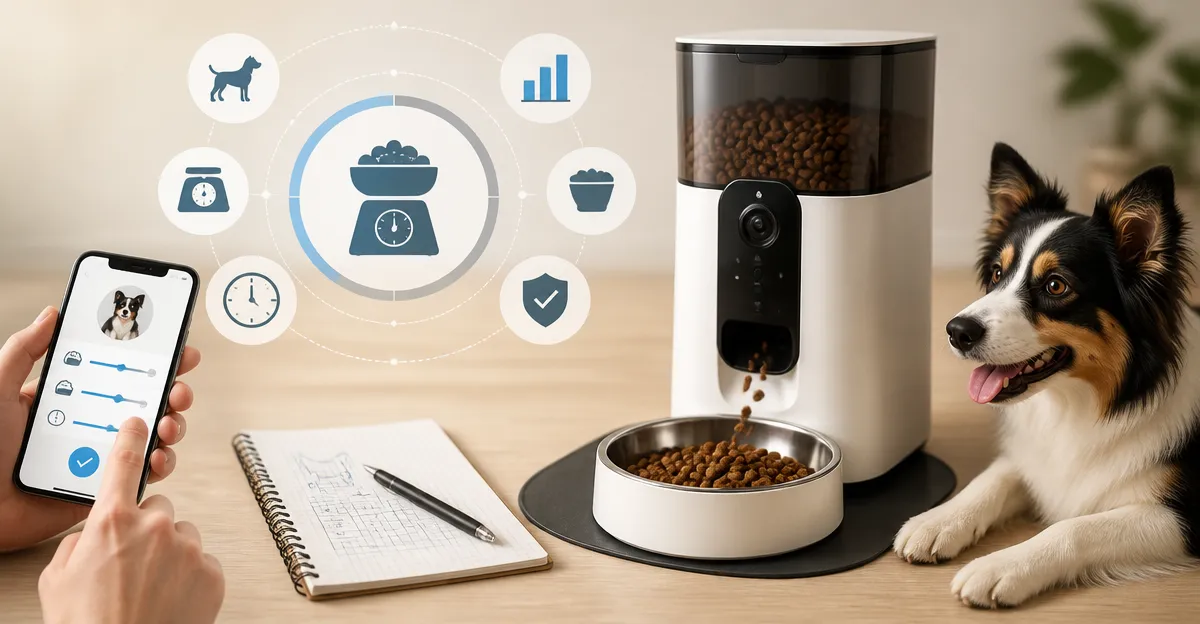
Ultimate Guide to Automatic Feeder Portion Size Calculators: How to Calculate Perfect Portions for Your Pet
Introduction
This guide explains how pet owners can determine the exact amount of food their cat or dog requires each day and how automatic feeders simplify the process. Readers will learn the scientific basis for portion calculation, how to use built‑in calculator features, and which products provide the most reliable results. By the end of the article, one will be able to create a personalized feeding schedule that supports optimal weight, health, and behavior.
The information presented combines veterinary nutrition principles with practical device knowledge. It is designed for pet parents who have intermediate experience with feeding routines and who seek a data‑driven approach.
Background and Context
Accurate portion control is essential because over‑feeding leads to obesity, while under‑feeding can cause malnutrition. Veterinary experts calculate daily caloric needs based on the animal’s weight, activity level, age, and metabolic rate. Most commercial pet foods list calories per cup or per kilogram, allowing owners to translate caloric targets into measurable portions.
Automatic feeders incorporate micro‑controllers that dispense a preset weight or volume of kibble at scheduled times. Modern models also feature voice recordings, Wi‑Fi connectivity, and RFID recognition, which help maintain consistent feeding even when the owner is away.
Understanding how these technologies work enables owners to trust the device’s calculations and avoid common pitfalls such as food jamming or inaccurate portion settings.
Key Concepts for Accurate Portion Calculation
1. Determining Daily Energy Requirements
The first step is to calculate the pet’s Resting Energy Requirement (RER) using the formula RER = 70 × (body weight in kg)0.75. For a 5 kg cat, RER equals approximately 70 × 50.75 ≈ 295 kcal. Multiplying RER by an activity factor (1.2 for sedentary, up to 2.0 for highly active) yields the Maintenance Energy Requirement (MER).
Owners should adjust the MER for life‑stage needs: growth, pregnancy, or senior health may require 10‑20 % more or less energy.
Once the daily kilocalorie target is known, the next step is to convert calories into food volume using the label’s “calories per cup” information.
2. Translating Calories to Feeder Settings
Automatic feeders typically allow users to set the number of “portions” per meal, where one portion equals a fixed weight (often 2.5 teaspoons or 5 grams). Knowing the weight of one portion enables precise conversion from calories to dispenser settings.
For example, if a dry food provides 350 kcal per cup and one portion weighs 5 g, then one cup (≈120 g) supplies 350 kcal. Therefore each gram supplies roughly 2.9 kcal, and a 5‑gram portion supplies about 14.5 kcal.
By dividing the daily kcal target by the kcal per portion, owners can determine how many portions to schedule across the day.
3. Accounting for Food Moisture and Density
Kibble density varies between brands. Some feeders, such as the ANDOLL HOME Automatic Cat Feeder, include a desiccant compartment that keeps food dry, ensuring the weight‑based portion remains accurate over time.
When using a feeder without a moisture control system, owners should monitor the food’s condition weekly and adjust portion settings if the kibble becomes compacted.
Product Recommendations Integrated with Portion Calculators
ANDOLL HOME Automatic Cat Feeder
The ANDOLL HOME model offers a 4 L capacity, voice recorder, and dual power options (USB adapter or three alkaline batteries). Its smooth feeding mechanism prevents blockage, which is critical for maintaining accurate portion delivery.
- Capacity: 4 L (approximately 8 lb of kibble)
- Portion control: Adjustable up to 8 meals per day
- Rating: 4.5 / 5.0 from 3,001 reviews
- Price: $30.99
Because the feeder includes a built‑in desiccant box, it preserves kibble weight, making the portion calculator reliable over weeks of use.
PETLIBRO 5L WiFi Automatic Cat Feeder
The PETLIBRO 5L WiFi model integrates a smartphone app that allows owners to program up to 10 meals per day and to view feeding logs. The app’s portion calculator displays the exact gram weight for each scheduled meal.
- Capacity: 5 L
- Wi‑Fi: Dual‑band (2.4 GHz and 5 GHz) connectivity
- Rating: 3.8 / 5.0 from 4,779 reviews
- Price: $79.99
Its infrared anti‑jam sensor stops dispensing when an obstruction is detected, protecting the accuracy of each portion.
DAAMENT Dual Bowl Automatic Cat Feeder
The DAAMENT feeder provides two independent bowls, allowing separate portion settings for each cat. This is especially useful for multi‑cat households where individualized calorie targets differ.
- Capacity: 6 L
- Dual power: USB‑C adapter or three C‑cell batteries
- Rating: 4.9 / 5.0 from 29 reviews
- Price: $49.99
Its transparent tank enables quick visual checks of remaining food, reducing the risk of unexpected shortages that could disrupt the calculator’s schedule.
PETLIBRO 3L Automatic Cat Feeder
This compact model offers up to six meals per day and precise portion increments from 1 to 50 portions (2.5 teaspoons each). The built‑in infrared safety stop ensures that jammed food does not affect subsequent meals.
- Capacity: 3 L
- Dual power: USB‑C plus three D‑cell batteries
- Rating: 4.4 / 5.0 from 8,851 reviews
- Price: $63.98
Its airtight storage and included desiccant bag maintain consistent kibble weight for accurate calculations.
PETLIBRO RFID Automatic Cat Feeder
The RFID version assigns a unique collar tag to each cat, allowing the feeder to dispense personalized portions only to the intended animal. This eliminates food stealing and ensures that each cat receives the calorie amount calculated for its specific needs.
- Capacity: 3 L (approximately 2 weeks of food for one cat)
- RFID collar tags for individualized feeding
- Rating: 4.2 / 5.0 from 19,276 reviews
- Price: $125.99
The app provides real‑time diet tracking, showing exactly how many grams each cat consumed, which aligns perfectly with a portion‑size calculator.
Comparison and Selection Guide
| Feature | ANDOLL HOME | PETLIBRO 5L WiFi | DAAMENT Dual Bowl | PETLIBRO 3L | PETLIBRO RFID |
|---|---|---|---|---|---|
| Capacity | 4 L | 5 L | 6 L | 3 L | 3 L |
| Meals per Day | 8 | 10 | 10 (per bowl) | 6 | 6 |
| Portion Precision | Adjustable by weight | 1‑48 portions per meal (1/12 cup each) | Custom per bowl | 1‑50 portions (2.5 tsp each) | 1‑50 portions (2.5 tsp each) |
| Power Options | USB‑adapter or 3 AA batteries | USB‑adapter, no battery backup | USB‑C or 3 C‑cell batteries | USB‑C + 3 D‑cell batteries | USB‑C + 3 D‑cell batteries |
| Smart Features | Voice recorder, LCD display | Wi‑Fi app, notifications | Tuya app, voice recorder | App control, infrared safety | RFID, app tracking, notifications |
| Price (USD) | $30.99 | $79.99 | $49.99 | $63.98 | $125.99 |
When selecting a feeder, owners should match the device’s capacity, meal frequency, and smart capabilities with their lifestyle and the number of pets they care for.
Best Practices and Tips for Using Portion‑Size Calculators
- Validate the Kibble Weight. Use a kitchen scale to confirm the weight of one portion as defined by the feeder. Adjust the feeder’s setting if the measured weight differs.
- Re‑calculate After Weight Changes. Pets often gain or lose weight; recalculate the MER monthly and update the feeder schedule accordingly.
- Maintain Dry Food Quality. Store kibble in an airtight container and replace desiccant packs regularly. Moisture alters weight and can cause over‑feeding.
- Utilize Voice or Meal Call Features. Recording a brief voice message, as offered by the ANDOLL HOME and DAAMENT feeders, reinforces routine and reduces anxiety.
- Monitor App Notifications. Devices such as the PETLIBRO RFID feeder send alerts for low food, jams, or battery issues. Respond promptly to avoid missed meals.
- Test the System Before Travel. Run the feeder for a full day without supervision to ensure portions are accurate and the device does not jam.
- Document Feeding Logs. Export the feeding history from the app and compare actual intake with the calculated target. Small discrepancies can indicate calibration drift.
Frequently Asked Questions
- How accurate are the portion settings on automatic feeders? Most modern feeders dispense within ±5 % of the programmed weight when the kibble is dry and of consistent size. Regular calibration with a kitchen scale improves accuracy.
- Can I use the feeder for wet food? Wet food is heavier per volume and may cause jamming. Only feeders explicitly designed for wet food, such as some models with a liquid‑compatible pump, should be used.
- Do I need an internet connection for the portion calculator? Devices with built‑in calculators (e.g., ANDOLL HOME) operate offline. Wi‑Fi models require internet only for remote app access and notifications.
- What happens during a power outage? Feeders with dual power options—USB adapter plus battery backup—automatically switch to battery mode, ensuring uninterrupted feeding.
- How do RFID feeders prevent food stealing? The collar tag activates the dispenser only when the designated cat is present. Other cats receive a locked lid, eliminating competition for food.
- Is there a subscription required for advanced features? None of the featured products require a mandatory subscription. Some apps offer optional premium services, but core feeding functions remain free.
- Can I adjust portions for a senior cat with reduced appetite? Yes. Reduce the portion size or increase the number of small meals per day using the feeder’s app or LCD controls.
Conclusion
Accurate portion‑size calculation combined with a reliable automatic feeder creates a feeding regimen that supports optimal health, reduces owner anxiety, and minimizes waste. By following the scientific formulas for energy needs, validating feeder settings with a scale, and selecting a device that matches one’s household dynamics, pet owners can achieve consistent, stress‑free meals.
The products highlighted in this guide each bring unique strengths: budget‑friendly reliability from ANDOLL HOME, advanced Wi‑Fi control from PETLIBRO 5L, dual‑bowl convenience from DAAMENT, compact precision from PETLIBRO 3L, and individualized RFID feeding for multi‑cat homes. Selecting the appropriate model empowers owners to implement the portion‑size calculator with confidence.
Products Featured in This Guide
ANDOLL HOME Automatic Cat Feeder
Price: $30.99 | Rating: 4.5 / 5.0 (3,001 reviews)
Featured for its dual power options, desiccant compartment, and reliable portion delivery without Wi‑Fi dependence.
PETLIBRO 5L WiFi Automatic Cat Feeder
Price: $79.99 | Rating: 3.8 / 5.0 (4,779 reviews)
Featured for its robust Wi‑Fi app, high meal frequency, and infrared jam detection.
DAAMENT Dual Bowl Automatic Cat Feeder
Price: $49.99 | Rating: 4.9 / 5.0 (29 reviews)
Featured for its two independent bowls, allowing separate portion calculations for each cat.
PETLIBRO 3L Automatic Cat Feeder
Price: $63.98 | Rating: 4.4 / 5.0 (8,851 reviews)
Featured for its compact size, precise portion increments, and infrared safety stop.
PETLIBRO RFID Automatic Cat Feeder
Price: $125.99 | Rating: 4.2 / 5.0 (19,276 reviews)
Featured for RFID‑based individualized feeding, real‑time diet tracking, and strong anti‑stealing design.